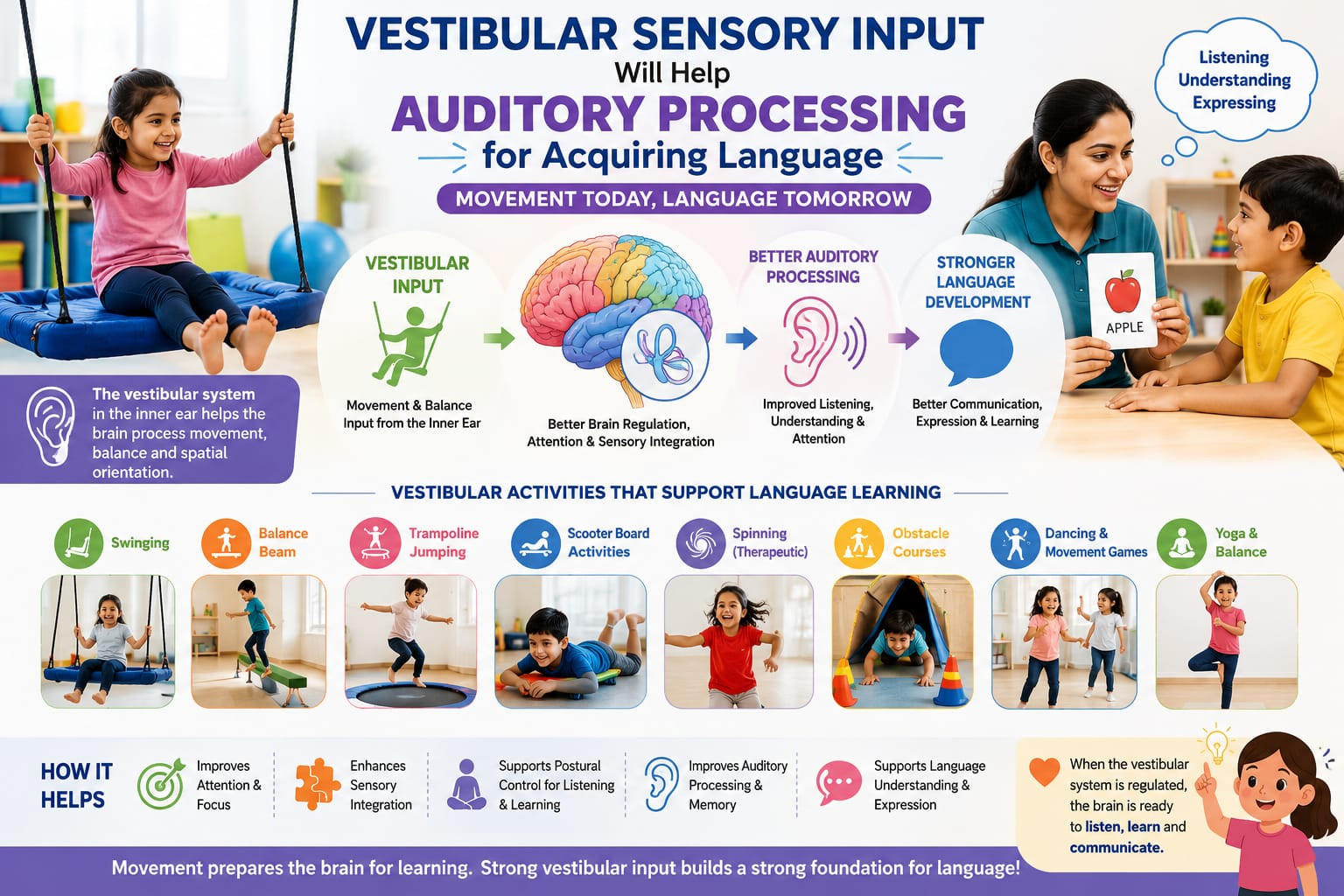
The vestibular system, located within the inner ear, is responsible for balance, movement, spatial orientation, and postural control. While many people associate it only with physical movement, research and clinical practice suggest that the vestibular system also plays an important role in supporting auditory processing, attention, and language development.
Understanding the Connection
For a child to understand and acquire language, the brain must effectively process auditory information. This involves:
Listening to sounds
Discriminating speech from background noise
Maintaining attention
Processing and remembering verbal information
Responding appropriately
The vestibular system contributes to these abilities by helping the brain regulate arousal, attention, and sensory integration.
How Vestibular Input Supports Auditory Processing
When children engage in movement activities such as swinging, spinning, balancing, climbing, or rocking, the vestibular system becomes activated. Appropriate vestibular stimulation can:
Improve alertness and attention
Enhance sensory integration
Support postural control needed for listening and learning
Improve coordination between the auditory and visual systems
Help the brain organize incoming sensory information more efficiently
As a result, children may become better able to focus on speech, follow instructions, and participate in communication activities.
Vestibular Activities That Can Support Language Learning
Some commonly used vestibular activities include:
Swinging (forward-backward or side-to-side)
Balance beam walking
Trampoline jumping
Scooter board activities
Spinning games (used carefully and therapeutically)
Obstacle courses
Dancing and movement games
Yoga and balance exercises
These activities are often incorporated into occupational therapy sessions before language-learning tasks to help prepare the brain for listening and communication.
Implications for Children with Neurodevelopmental Disorders
Children with autism, ADHD, developmental delays, sensory processing difficulties, and language disorders often benefit from structured vestibular input. When carefully planned and individualized, movement-based activities can help improve attention, engagement, and readiness for language acquisition.
Conclusion
Language development does not occur in isolation. The brain's ability to process sounds, attend to speech, and communicate effectively is closely linked to sensory systems, including the vestibular system. By providing appropriate vestibular sensory experiences, educators, therapists, and parents can create a stronger foundation for auditory processing and language learning.
"Movement prepares the brain for learning. When the vestibular system is regulated, listening becomes easier, attention improves, and language has a better opportunity to flourish."
— OutReach Special School & Therapy Centre, Pollachi

 Click to Chat